
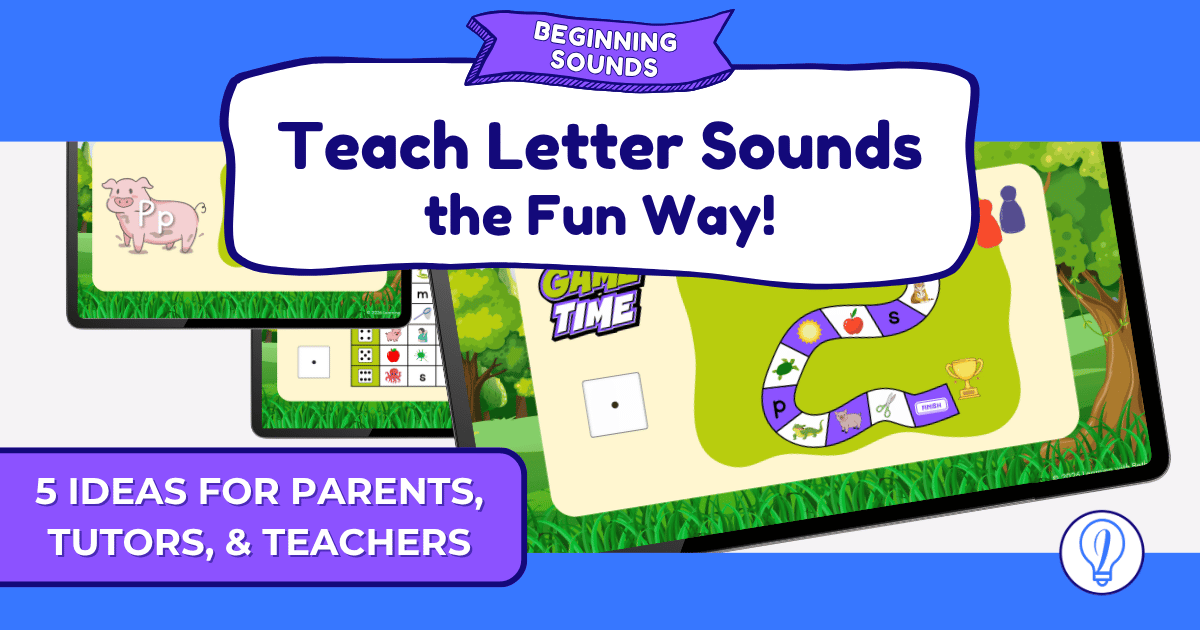
Letter sounds don’t have to mean repetitive flashcard practice and grumbles. When kids sing, play, and move, they actually want to learn, and are more likely to retain what they learn.
Letter-sound knowledge is the foundation for learning to read, so it’s worth making this stage something kids look forward to. Whether you’re a parent teaching at home, a tutor, or a teacher, here are five simple things that make practicing letter sounds more fun and more effective.
1. Songs
Pair each letter with a carefully chosen keyword to help kids remember its sound. Add a catchy song for each letter sound and kids will love it! Sing the song line-by-line, having your child repeat it back to you. It is even more memorable when you add in silly movements. Each song has the letter sound and keyword built in twice. Repetition feels natural when it’s a song, so kids get plenty of practice without noticing.

2. Animations
On-screen movement draws kids’ eyes back to the lesson. A little animation brings each letter and its picture to life, which helps young children stay focused.

3. Tracing
Practicing the physical motions for writing each letter deeply strengthens learning. Have your child trace the letter with their finger while saying its sound out loud. This powerful combination of seeing, saying, and physically moving builds muscle memory, helping the letter and sound stick together. A printable tracing and coloring page also offers a perfect opportunity for kids to practice away from the screen.


4. Activities
Offering a variety of practice options lets you pick and choose activities tailored directly to your child’s interests. You can mix things up with letter-find games, sorting images by their beginning sounds, or identifying the first, middle, and final sounds to build a whole word. This variety keeps the concept fresh, prevents boredom, and lets kids apply their letter-sound knowledge in different ways as their skills grow.


5. Games
Turn review into a playtime favorite. Simple games like tic-tac-toe, roll and read, and four-in-a-row let kids practice their letter sounds over and over without feeling like they are working. Since these formats are endlessly replayable, kids get the repetitive practice they need to build instant recognition, all while simply trying to win the game.

Stop While They’re Still Having Fun
The best way to keep kids coming back is to end on a high note. That is why there is a game at the end of every lesson. If your child is smiling and engaged, you’ve done it right. Happy kids look forward to the next lesson.
Put It All Together
If you’d like all of this planned for you, my Beginning Sounds Alphabet Phonics Curriculum puts it together in 32 digital lessons. Every letter comes with a song, a carefully chosen keyword image, animations, practice activities, and games, all shared on your screen, plus a printable tracing and coloring page.
The letters are taught in a purposeful order, not A-B-C. Lesson 1 starts with two letters, A and T. After that, each lesson introduces one letter at a time, with a review after every 3 to 4 letters so nothing gets left behind.
Whether you’re a parent, tutor, or teacher, you can open a lesson and play.
See the Beginning Sounds Alphabet Phonics Curriculum here

Happy Teaching!
Beth Walker believes in promoting student success through a patient and encouraging environment. As an online educator since 2018, she specializes in reading tutoring at Learning with Beth. She adapts her teaching techniques to best fit each student’s needs and interests; striving to make each class enjoyable for her students.
Leave a Reply